A Bungling Attempt To Silence Voices
I watched the short documentary The Ban: When a Crackdown Involving the I.R.A. Backfired, Comically on The New Yorker’s YouTube channel. The description of the film reads, “In 1988, when the British government declared that the voices of Sinn Féin or I.R.A. [Irish Republican Army} leaders were not to be heard, broadcasters soon discovered a loophole.” This was a telling moment in the history of the Troubles - a conflict in Northern Ireland over its constitutional status, between unionists, who wanted to remain in the United Kingdom, against nationalists, who strived for a united Ireland. The censorship reveals so much about the desperation, a need for some form of control, in the midst of seemingly unstoppable violence.
Spoiler Alert! To make up for not being able to use the actual voices of Sinn Féin or I.R.A., actors were hired to dub for them, in a newly created niche that proved increasingly competitive and lucrative, It also resulted in unintentional comedy. Both the lighter side and the more serious ramifications of the silencing of the voices of the Irish Republican movement, are discussed in The Ban. The nearly 30 minute film uses voiceovers, archival footage from Northern Ireland Screen Digital Film Archive. and interviews with key figures, such as Gerry Adams, the former Sinn Féin leader from 1983 to 2018.
It is directed and co-produced by Roisin Agnew, who has a “cross-border heritage” with a mother from Dublin and a father from just outside of Derry (in Northern Ireland). Her upbringing was in Rome. In an interview with Northern Ireland Screen, she explained what drew her to this project. She said she realized that in 2024 it had been the 30th anniversary of the lifting of the broadcasting ban, which had been implemented by Margaret Thatcher, who served as prime minister of the United Kingdom, from 1979 to 1990, and the I.R.A. ceasefire, which led to the peace process.
Ms. Agnew explained, “It just made sense to make a film about it, as it was both absurd and inherently cinematic – a cottage industry of Northern Irish actors dubbing members of Sinn Féin and the I.R.A. Our approach towards the sensitivity of the subject matter was simply to narrow the perspective as much as possible and not try to be objective, it’s an impossibility anyway. We focused on the perspective of those involved directly in the technical process of dubbing – the journalists, broadcasters, actors, and political figures being dubbed. We wanted a lightness of touch despite the tragic and serious stories that this process was entangled with during the period we focus on (1988 – 1994), but we tried to do this with sensitivity.”
That sensitivity involved consulting with “survivors and family members, so we showed the film to WAVE Trauma Centre before ever screening it or calling final cut.” (The WAVE (Widows Against Violence Empower) Trauma Centre is a Northern Ireland-based charity that provides care and support to anyone who has suffered because of the Troubles, whether through injury, the loss of a loved one or other types of trauma from the violence.) Another person who viewed the documentary was Colm Tóibín, the renowned Irish novelist and journalist. He wrote about it on October 29, 2025 for The New Yorker.
He explained Mrs. Thatcher’s concerns at the time, which are also elucidated in the film. “Her displeasure could only have increased in October, 1984, when the I.R.A. planted a bomb in a Brighton hotel that narrowly missed her. The I.R.A.’s statement in the aftermath—’Remember we have only to be lucky once, you will have to be lucky always’—made clear that she was dealing with a powerful enemy, as skilled at pithy and memorable statements as in the use of explosives. In a speech the following year, Thatcher said, ‘We must try to find ways to starve the terrorist and the hijacker of the oxygen of publicity on which they depend.’ She called on the British media to self-regulate in order to prevent the kind of situation in which a spokesman for Sinn Féin could appear on television after an I.R.A. outrage and calmly claim that it was all in the name of Irish freedom.”
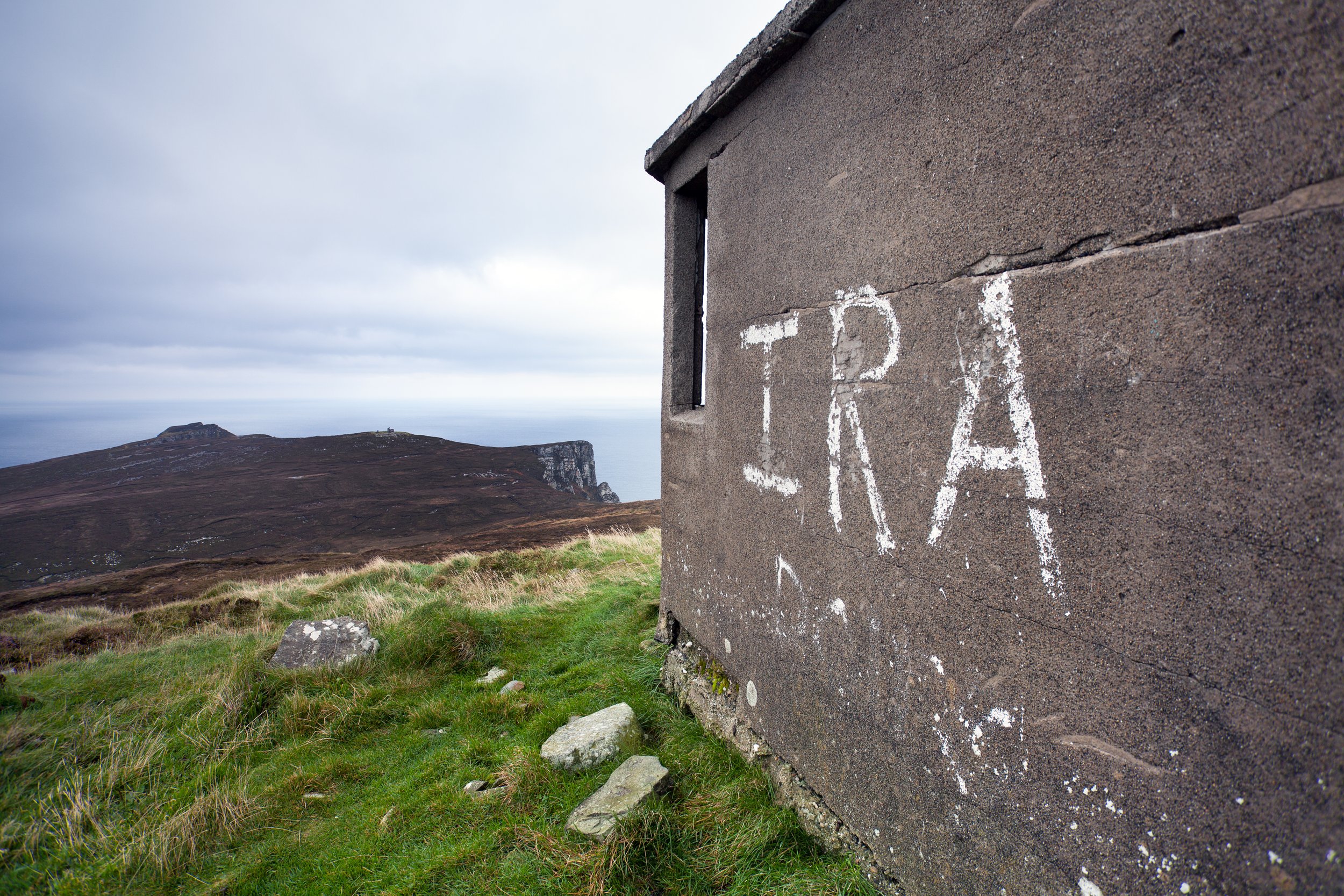
IRA graffiti on Horn Head, Ireland
What worried Mrs. Thatcher was how gifted the I.R.A.’s political wing was at communication, including, of course, Mr. Adams, but also Danny Morrison, Sinn Féin’s director of publicity and Martin McGuinness, “Adams’s deputy in Derry,” Mr. Tóibín wrote,“Part of the threat that these men posed was their ability to speak like reasonable politicians while effectively running a ruthless terrorist campaign.” Against a black backdrop in vibrant green type, the documentary reveals a jaw-dropping fact. “The year leading up to the ban saw an escalation of violence. In August of 1988, two months before the ban, the I.R.A. launched nearly 200 attacks on the police in a single day.” This is followed by scenes of violence, including at funerals.
Yet, as both Mr. Tóibín and the documentary explain, the British weren’t the only ones censoring the media. In 1961, the Irish government enacted the right to censor broadcasts and in 1971 they banned Sinn Féin and the I.R.A. from their programs. The British government did not have an all-encompassing ban like that in place and when they did create the ban declaring that the voices of Sinn Féin or I.R.A. were not to be heard on the television or the radio, the loophole of actors dubbing the voices got around the censors. A lot of people, including Mr. Tóibín got a kick out of this.
“In the six years that the ban lasted (like the Irish ban, it ended in 1994), while watching interviews on the British news channels, you tried to guess which actor was doing the dubbing. I was in Dublin then, and it was a time when the booming presence of Mrs. Thatcher loomed large. I wondered what cause she believed these voice-overs served, other than providing glee for the nation. For example, did she listen to Stephen Rea playing Adams? Of all the actors, Rea [who is briefly interviewed in the documentary] stood apart. Because he was married to a former I.R.A. bomber, there were objections to his presence on air. But the real problem was that he could embody any role that he took on with consummate and uncanny skill.”
Indeed it does not seem there was forethought about the pitfall of hiring a talented actor, like Mr. Rea—who Mr. Tóibín felt was sometimes an even more effective communicator than Mr. Adams, “less self-satisfied and sanctimonious.” Mr Adams himself jokes about the skill of the voice actors in the documentary. “Well, a lot of people thought it was a great improvement, you know, on my monotone.” He also said, “People would bring it to your attention that there was a particularly funny, you know, or somebody with a squeaky voice or clearly not me, for those who may have known me.” Some of the voices may have been humorous, even if unwittingly, but actors were discouraged from doing too good of a job. “The whole history of Anglo involvement in Irish affairs is steeped in propaganda and in demonization and vilification,” he said. “Because you can’t go about the job of dealing with people as commodities. You have to dehumanize them, you have to demonize them to get away with that.”
Yet, political satire highlighted the hypocrisy of the ban. The documentary shared a clip of Steve Coogan, the British actor and comedian, on The Day Today, a British comedy television show. He was playing the part of Rory O'Connor, a fictional Sinn Féin spokesperson who has to suck on helium so that he can maintain a high-pitched voice while giving a statement.
The YouTube comments section of The New Yorker documentary revealed people’s feelings about the ban, and the strange, if somewhat amusing, atmosphere it had created in their lives. For example, @billkingston4402, wrote, “Remember this, born in London to Irish parents and Adam's [sic] voice ban became a joke at school, as a result Sein Fein [sic] got a lot more attention in British news, why?, people don't like being censored.” Also, @davidwalterhall wrote, “Growing up in Northern Ireland, born in 1983, I was too young to remember before the ban. The ban was the normal of my first encounters with the TV news. I do remember coming into school the day after the ban, to a playground full of people who claimed to have heard GERRY ADAMS'S VOICE! I hadn't. I don't know who really had. Everyone claimed it was magnificent. We must have thought that's why they banned it in the first place. It was too beautiful, too arresting and charismatic to be broadcast. Were we all about to be turned?” Another commenter, @DM-GRPRT wrote “I lived through it. There was an irony that they used actors on TV in Britain and the north but not in Ireland. And all of Ireland received RTE [Ireland’s national media]. So you just had to switch channels to hear the real voice. It was a joke in all aspects. Both practically and politically on the subject of free speech.” Graham Williamson, who wrote a review of the film on Letterboxd, the social networking app and website for film enthusiasts to track, review and rate movies, explained that the ban had a real impact on British society. “Chief among these effects is that it made the country a slightly more ridiculous place, to have the news suddenly turn into the equivalent of a badly-dubbed spaghetti Western every time Gerry Adams or Martin McGuinness turned up,” he wrote.
As an American, it was interesting to listen to the part of the documentary that focused on the role the ban played in garnering American sympathy. Mr. Adams felt it piqued the curiosity of Americans. “When I got to go to the U.S.A., a lot of the media interest was in listening to this person’s voice who was banned from the airwaves. Just shows you how counterproductive it is because, had I not had these measures in place, it wouldn’t have been a story.” It is also suggested in the film that just being silenced by the British was enough to turn public opinion against Britain in the United States or Europe, even if there was no further understanding of the conflict than that. After all, Sinn Féin had established themselves as a legitimate political party. However, another voice-over also wonders if the ban helped Mr. Adams escape accountability. Meanwhile British soldiers were also dying and British citizens also had this deeply personal stake in the free flow of information and were hurt by the ban.
Still, Ms. Agnew argues that despite the ban’s ironic consequences and comedic fallout, the debacle offers vital lessons regarding the genocide in Gaza. “Over the past year there’s been a growing public awareness of the media’s capacity to manipulate language, reported speech, and real events in service of a political narrative and how this has real, material implications,” she said.
She continued, “Media’s complicity with various states has paved the way to the genocide we see unfold on our phone screens every day and I sincerely hope the media’s part in this is eventually held up to scrutiny. The Ban is set at a marked spatial temporal distance from this, but deals with the idea of the media as a front along which a conflict is fought; how it was used to create a lacuna in the British public imaginary when it came to the North, which in itself dehumanised its subjects and prolonged the conflict. Looking at a historical event with shared similarities has the capacity to give a new perspective somewhat stripped of emotion, I think.’