The Kennedys - A Multigenerational Story Carried By The Sea
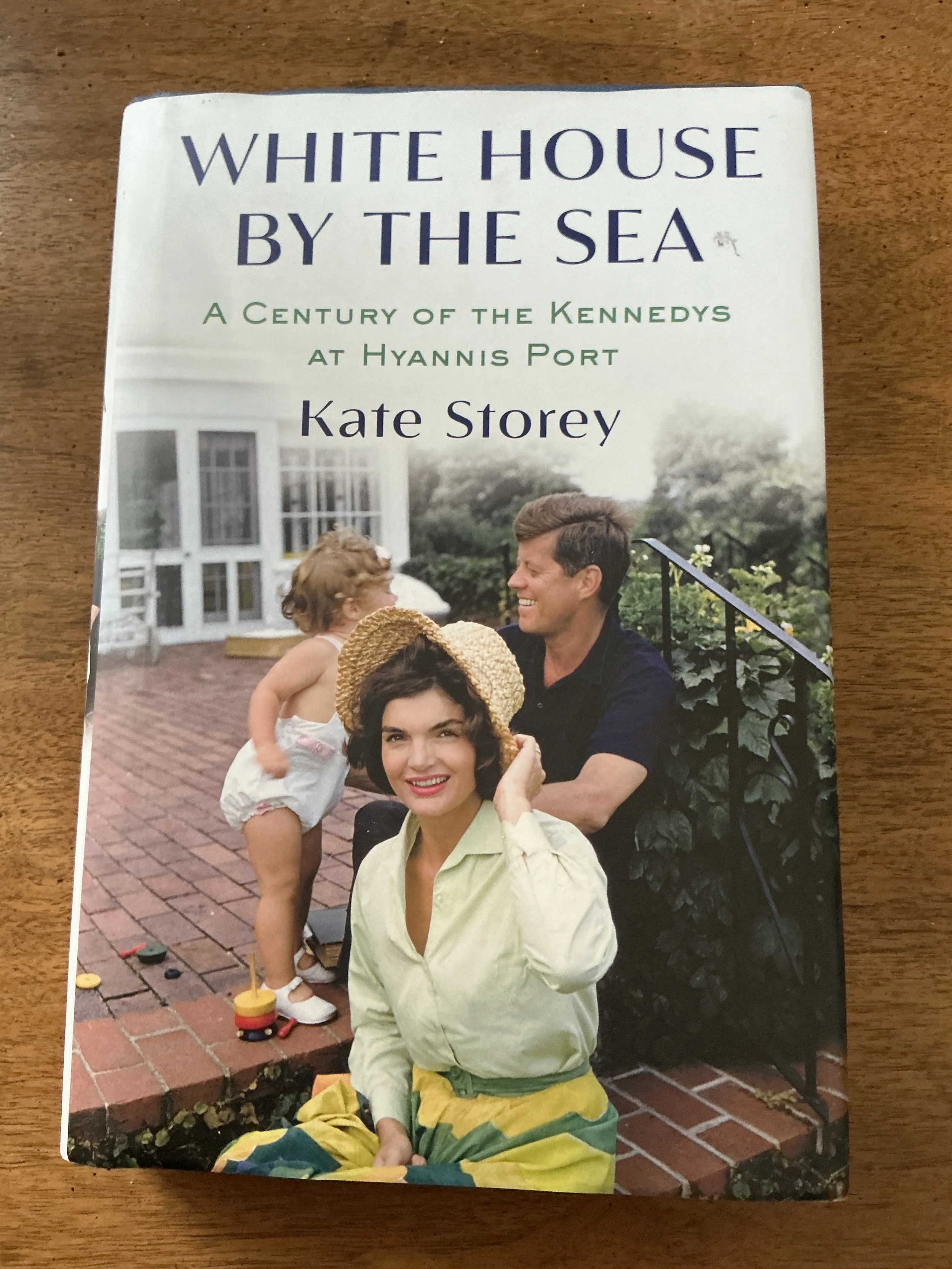
Before Tatiana Schlossberg, Caroline Kennedy’s daughter, tragically passed away from leukemia at just 35 years old, after writing a heart-wrenching essay for The New Yorker and her brother, Jack Schlossberg, started campaigning for Congress and before pop culture became obsessed with, “Love Story: John F. Kennedy Jr. & Carolyn Bessette,” a popular, yet controversial dramatization on FX and Hulu of the Kennedy heir’s relationship with his wife, I was already reading White House By The Sea: A Century Of The Kennedys At Hyannis Port by Kate Storey, aloud to my mother, Marian. The saga of the Kennedys continues to fascinate the world and the book is an engrossing, multigenerational story of the famous political family’s lives at their summer homes - including the Kennedy compound - in and around Hyannis Port, a seaside village in the town of Barnstable, Massachusetts on Cape Cod. It was a meaningful story to share with my mom as, like the Kennedys (but without the immense privilege and fame) we both embody different generations of the Irish American experience. Also, as a native of the Midwestern United States and a member of a small family, I was fascinated by the idea of having the ocean in your backyard and growing up amongst numerous aunts, uncles and cousins. However, what struck me was that while the focus, of course, was on their experiences at their summer homes in the United States, there was a special connection to Ireland.
Inherent in the Kennedy’s sense of belonging and their origin story is a reverence for the sea. Sadly, it was the burial site for John F. Kennedy Jr., 38, Carolyn Bessette-Kennedy, 33, and one of her sisters, Lauren Bessette, 34, after a plane crash off Martha’s Vineyard 26 years ago. In his 1962 America’s Cup speech, President John F. Kennedy said, “I really don't know why it is that all of us are so committed to the sea, except I think it is because in addition to the fact that the sea changes and the light changes, and ships change, it is because we all came from the sea. And it is an interesting biological fact that all of us have, in our veins the exact same percentage of salt in our blood that exists in the ocean, and, therefore, we have salt in our blood, in our sweat, in our tears. We are tied to the ocean. And when we go back to the sea, whether it is to sail or to watch it we are going back from whence we came.” The Atlantic Ocean connects the Kennedy family Cape Cod sanctuary with their ancestral home.
Kennedy compound
Indeed, in the book, Ms. Storey, the author and senior features editor at Rolling Stone and former staff writer at Esquire, writes that on November 22, 1983, the 20th anniversary of President Kennedy’s assassination, Senator Ted Kennedy spoke to an audience at Holy Trinity Church in Washington, D.C. He recalled one of his favorite memories of Jack, when they were walking on the beach behind their parents’ home - the Big House - with its breakwater, designed to protect the land from the force of the ocean waves. "‘He said to me when I was very young,’ Ted began, ‘on a clear day you can see all the way to Ireland” (208-209).
Ireland was also present, as a sentimental connection to an elegant object that was almost a talisman, in a memory recalled by Billy Noonan, a close friend of JFK Jr. from his early teens, whom he met on Cape Cod. Ms. Storey writes, “As the summer wound down in 1996, John invited Noonan and Kathleen [his wife] and their brand-new baby to the house for the weekend. It would just be the five of them - no dinner parties. Provi Paredes [First Lady Jacqueline Kennedy Onassis’ special assistant and confidante] brought out frosted Waterford goblets - engraved with the Kennedy family crest and inscribed with ‘John-John’ and ‘Caroline’ - from one of John’s childhood trips to Ireland. As soon as Paredes left, Noonan could tell from John and Carolyn’s expressions that they were about to reveal something big. Before they said a word, he knew: they were getting married. They peppered John and Carolyn with questions: When did the proposal happen? How? Where? When’s the wedding?” (240).
Two generations before that stemware from the iconic Irish Waterford Crystal was brought out to mark a special occasion, it seems as if Joseph P. Kennedy Sr., the patriarch, wanted to bring the life force, beauty and prestige of the Emerald Isle to the United States, through their horses, of which the Irish also have a reputation for excellence. The books reads, “While Joe went riding, Teddy [Senator Ted Kennedy as a child.] walked along the shore looking for little holes in the sand where he could dig for steamers. But if the tide was high, Teddy got to ride with his father. Joe mounted his horse, while Teddy rode Blue Boy, a gentle, old stallion that his brothers had ridden for years. Joe had his horses brought over from Ireland. He liked to say it cost more to ship them over than the value of the horses themselves, but they all had good, sweet dispositions” (45).
An Irish American classic that was one of Rose Kennedy’s favorites.
It was not only horses that were brought over from Ireland, but also Irish domestic workers, according to White House. “But with Bobby and Jack gone and Joe unable to communicate [due to a severe stroke], Hyannis Port became something of a matriarchy, with the widows left to run things, with the help of their revolving cast of governesses, sailing instructors, and ‘Irish bunnies,’ as Ted Kennedy called the young women Ethel brought over from Ireland for the summer” (158).
In The New York Times review of the book,“Where Kennedys Sail and Play Football, Others Cook and Clean,'‘ by Louis Bayard, the reviewer and author of a historical fiction novel about Jacqueline Kennedy Onassis, shares the same confusion as I do about the “Irish bunnies” reference. He writes, “It was Jackie who, in the days after her husband’s assassination, first planted the lyrics of ‘Camelot’ in a credulous journalist’s ear, but it is Storey who insists six decades later that Hyannis Port is ‘what’s left of Camelot,’ even as her own research suggests just how much of that myth rested on actual human backs: nannies, governesses, cooks, nurses, drivers, sailing instructors, tennis instructors, gardeners, landscapers, personal assistants — even young female ‘Irish bunnies,’ who were, for reasons unclear, imported every summer.”
Did Ethel Kennedy, who had 11 children, choose workers from Ireland because she felt she could trust them more because of a shared cultural link? Did she feel a responsibility to hire these women because of possible prejudice, mostly against Irish Catholics, immigrants and women? Was she trying to help them find a way to safely establish themselves in America? Were they helped in ways beyond employment? Again, was there a certain prestige in hiring people from Ireland? Also, what is the deal with calling them “Irish bunnies?” Is that a term of endearment? Is it sexist and disrespectful or all of the above? Did the Irish women help with the children? Did they clean? What was their experience? How were they treated? There is a gaping silence, where these women’s voices should be heard. Of course, this is probably because an implied part of their job description was discretion. (There is documentation of two of the domestic workers, one of whom was an Irish woman named Mary O'Donahue, at Joseph P. and Rose Fitzgerald Kennedy’s home in Brookline, Massachusetts from 1914 to 1920, but that is a generation before Ethel Kennedy.)
Despite this mystery, the Kennedys did make strides for women with the appointment of Jean Kennedy Smith, the eighth child of Joseph and Rose Kennedy, as United States ambassador to Ireland, She was appointed by President Bill Clinton in 1993 and served until 1998. She played a key role in the Northern Ireland peace process.
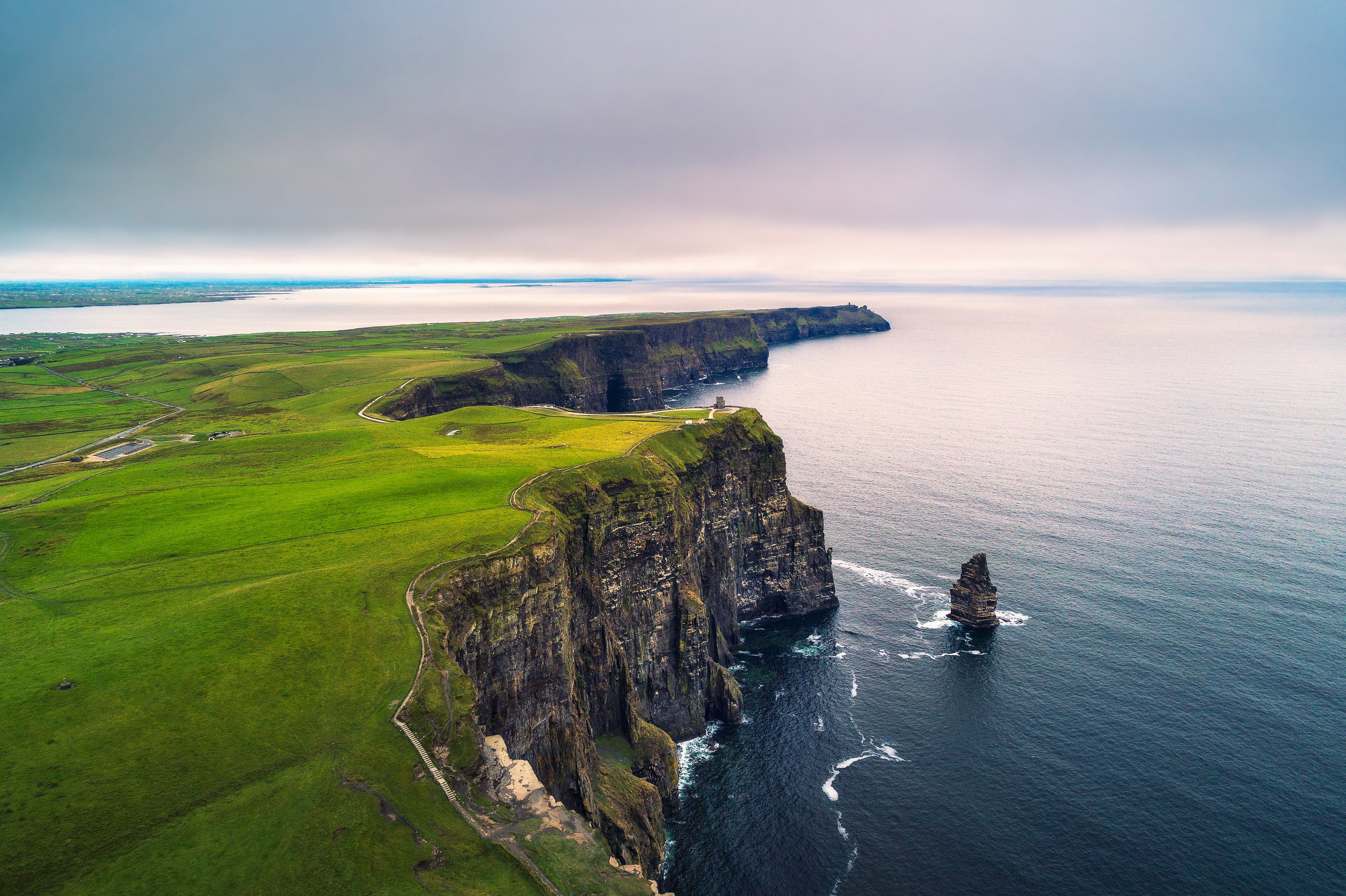
The Cliffs of Moher in Ireland.
In addition, the Irish also became family when Courtney Kennedy Hill, the fifth child of the late Robert F. Kennedy and Ethel Kennedy married Paul Hill, an Irish activist and member of the Guildford Four, who were wrongfully convicted of the 1974 IRA pub bombings in Guildford, England. They separated but share a daughter, Saoirse Roisin Kennedy Hill. Tragically, Saoirse, whose name means “liberty” and “freedom” in Irish and is pronounced “SEER-sha” or “SUR-sha,” passed away at Hyannis Port in her sleep on August 1, 2019 from an accidental overdose. She unwittingly combined prescription medications, including methadone, with alcohol, which are depressants of the central nervous system. She was only 22 years old.
In White House, she is described as, “The most outgoing of Ethel’s grandchildren,” “an only child” and, “a girl with dirty-blond hair.” Ms. Storey writes, “From when she was a little girl with her father’s Irish accent, Saoirse spent a lot of her time on the Cape with her mother and grandmother; she loved the water and spending time with all her cousins and aunts and uncles.” She watched football games with her grandmother; ”the two liked sitting together in Ethel’s cozy living room on her overstuffed sofas to watch Patriots games” (267).
The author writes,“Saoirse was a big personality, beautiful with round eyes, full cheeks, and a warm smile. People in town took note when they met her. When Saoirse dropped off half a dozen pieces to get tailored in town, the seamstress noticed the name on the receipt and asked Saoirse if she was a Kennedy. ‘Yes, I am,’ she replied. ‘Ethel’s my grandmother.’ The seamstress excitedly told her, “You are my first fourth generation! I’ve had so many of the third generation. But you are my first fourth generation! I wish I had a bell I could ring.’ Saoirse laughed. While some of her cousins would politely smile when they heard things like this from neighbors, feigning interest, Saoirse sat in the shop, listening to the seamstress share her memories of her mom, her grandmother, and her great-grandmother Rose” (267-268).
In his eulogy, Saoirse’s uncle, Robert F. Kennedy Jr., said, “Saoirse was born in Washington, D.C. but she spent ages four through eight in Ireland. When my younger kids first met her on Cape Cod, she was an adorable, flaxen-haired Irish sprite, with sparkling eyes, peeling laughter, and a thick brogue.” He then went on to say,“Saoirse’s heart was on the sea. She considered herself a citizen of Ireland and America, but most of all, the borderless, boundless oceans.”