Unsung Heroes: "Emerald Nightingales: Irish Nurses in the NHS"
I already have such admiration for nurses and their dedication to patients, but when I watched the documentary Emerald Nightingales: Irish Nurses in the NHS, as part of the Chicago Irish Film Festival, I was even more impressed by the 30,000 young Irish women (and some men) who traveled to the United Kingdom to fill an important need beginning after World War II. (I have an online pass to the festival. There were also tickets for theater viewing. Also, spoiler alert! I reveal anecdotes from the film.)
This is a story I knew nothing about and I’m so glad that the documentary exists as a tribute to such honest and good people who dedicated their lives to caring for others with grace and humor in their deepest time of need, for example, by reading a bedtime story to a boy named Michael battling leukemia even after a shift has ended or sitting with a patient who would otherwise have been dying alone. The nurses came from rural Ireland, where opportunities were closed to the poor. They overcame seasickness and homesickness to have fulfilling careers. I sensed that they channeled the determination from their own journeys into giving their patients the best outcomes on theirs. Director Tom McGorrian used testimonials from the women who are retired juxtaposed with photographs of them from their nursing days and family photographs, which was moving. He also used archival footage.
In a voice-over, actor and former nurse Helen Behan explains that, “After the war Britain was dealing with food shortages, disease and a housing crisis that left many struggling to find stability, but from this hardship something new started to take shape, a bold vision, the NHS (National Health Service) was born, bringing with it a sense of hope and a new beginning.” Britain would have access to free healthcare. (As an American, this is an astonishing, revolutionary concept to me. It is mostly a private system here that is rooted in capitalism and not in healthcare as a human right.) This noble endeavor needed nurses, however, and there was a “massive shortage.” The British government started recruiting nurses from Ireland.
Irish Times
Nurse Lorna Keating, whose career was from 1972-2021, was born in County Sligo. She recalls,”…which is out in the sticks basically and my parents were farmers. Yeah, I was one of 10. Looking back it must have been pretty tough, especially for my parents. We went to the local national school, which is about two miles and from the age of four, you had to walk those two miles - mainly in wellingtons, although at that time there were some families actually who went to school barefooted, even in 1953, which is sad.”
Family size was also an influence on their chosen profession. Rosemary McLoughlin, who was a nurse from 1968 to 2012, said, “I’m one of 11 children. I actually think because…of the large family, it’s natural to actually look after the younger members of the family and to be left with great responsibilities. It just seems a natural progression for me to after looking after my brothers and sisters to take up a career in nursing.”
Also Rosanna Anderson, a nurse from 1966-2019, who was brought up on a farm, recalled that in the 40s and 50s it was difficult to find work in Ireland. If you trained as a nurse, you could go from a small village in the west of Ireland to Britain. Anne Brennan, a nurse from 1963-2013 said, “You could get into the hospitals in Ireland if you had plenty of money and that was impossible for me to do.” It was easier for her to get free training at a British hospital.
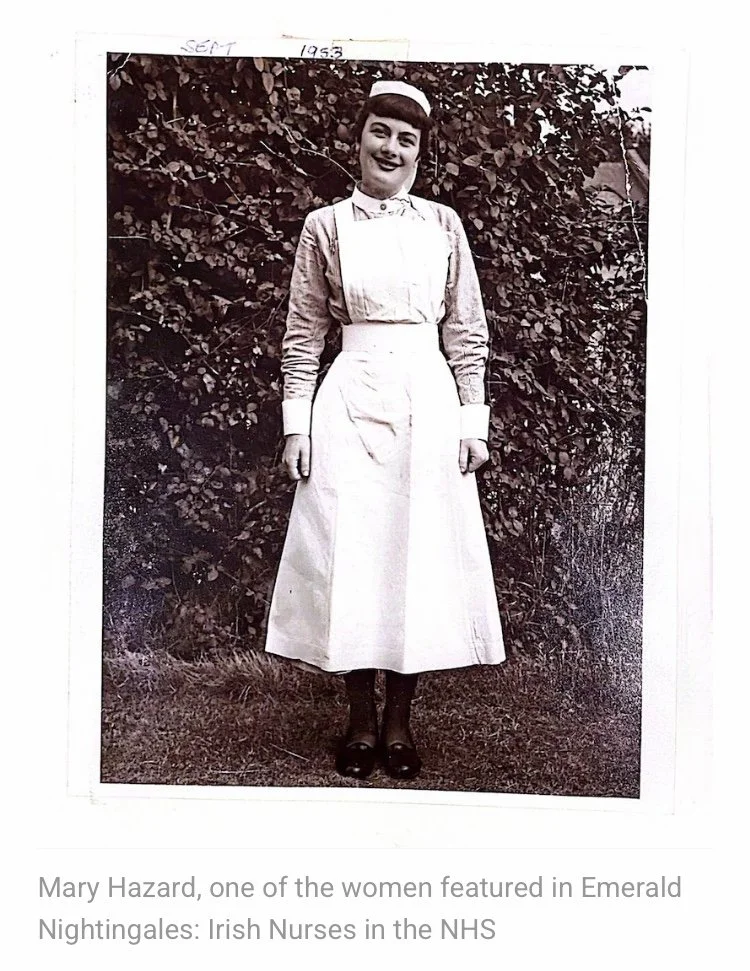
There were concerns about working in Britain though. Mary Hazard, a nurse from 1952-2013, recalled her mother’s reaction. “But of course there was the abhorrence of England at the time and my mother said over my dead body - well to a Protestant country and no one went to mass and my mother was a very strong-minded Catholic snob I would say that about her without being too derogatory. She was a kind lady but she was very emphatic about what she wanted. So I was rebellious because I spent all my years at the convent so the only way to get away from them was to come to England.”
It is also interesting that America is mentioned, as a testament to the Irish spirit by Lorna Keating. “I think I do have that wanderlust as a people because it’s historically…People went to America as you know and I think that was kind of then ingrained in us, that was kind of the norm then, that as soon as you finished your schooling, you just took off.”
Beyond the strict routine of education and of helping patients with tuberculosis and measles, the nurses had fun at dinner dances and rock and roll performances. They would sneak in after the 10 p.m. curfew with the help of a fellow classmate who would leave the door open for them or they would use a window.
It was an enlightening multicultural experience for many of the women, but they did encounter anti-Irish sentiment during the IRA bombing campaign of the 1970s and 80s, according to Professor Louise Ryan, Director of the Global Diversities and Inequalities Research Centre London Metropolitan University. She said, “And they told us how that impacted on them where patients for example might make snide remarks on the ward or one particular example that was told to us where a soldier who had come back from Northern Ireland where he had been injured and was being treated in the hospital absolutely refused to have an Irish nurse treat him because he just didn’t want to have anything to do with an Irish nurse.”
Bernie Naughton, who was a nurse from 1965-2020, recalled how difficult it was to be a nurse after the Birmingham bombs. “If you were Irish there you put your head down and you made sure sort of you didn’t speak because it wasn’t a pleasant place. I was different. I was a potential bomber.”
All of the nurses who were interviewed, however, spoke of their nursing careers as something that gave them a sense of purpose, despite hardships. Mary Hazard, who passed away in 2025, as noted in the film, said, “I think I had a great career. I learned a lot. It was my whole life - nursing. I loved it.”